Purity is the share of pure gold. 24K gold contains at least 99.9% gold; 23K (980) about 98%; Italian 750 is 18K at 75%; 710, 680 and 610 gold contain about 71%, 68% and 61%. Higher purity means more gold, a deeper colour and a higher price, but a softer metal. Choose 24K for saving; 750 or fashion gold for daily wear and gem-setting.
What is gold purity?
Purity (Vietnamese: *tuổi vàng*, literally "gold age") is the share of pure gold in an item. Pure gold is very soft, so jewellers add silver, copper, zinc or palladium for hardness and colour. The more gold, the higher the purity.
Traditionally, 24K is called "ten-age gold" (*vàng mười*) in Vietnam. The national standard TCVN 7054:2014 requires 24K gold to contain at least 99.9% gold.
Two ways to write purity: karats and parts per thousand
- Karat (K): gold divided into 24 parts. 24K is pure; each karat is about 4.17%. 18K = 18/24 = 75%.
- Parts per thousand (‰): the number of gold parts in 1,000. 750 means 75%, i.e. 18K; 610 means 61%.
Convert with: karat = fineness × 24 ÷ 1,000. So 610 ≈ 14.6K, 680 ≈ 16.3K and 710 ≈ 17K. The stamp is usually inside a ring, on a necklace clasp or on an earring post.
Common gold types at a glance
| Name | Stamp | Gold content | Equivalent | Character |
|---|---|---|---|---|
| 24K gold (9999 gold) | 999 / 9999 | ≥ 99.9% | 24K | Deep yellow, very soft |
| 23K gold | 980 | ≈ 98% | ≈ 23.5K | Deep yellow, soft |
| Italian 750 | 750 | 75% | 18K | Hard, many colours, fine work |
| 710 gold | 710 | 71% | ≈ 17K | Fairly deep colour, hard |
| 680 gold | 680 | 68% | ≈ 16.3K | Medium yellow, hard |
| 610 gold | 610 | 61% | ≈ 14.6K | Lighter colour, hardest |
| International 14K | 585 | 58.5% | 14K | Common in imported jewellery |
| 10K gold | 417 | 41.7% | 10K | Hard, low price |
Content is the share of pure gold by weight. Ngọc Diệp sells 24K, 23K, 750 and 610/680/710.
24K and 23K: the highest value
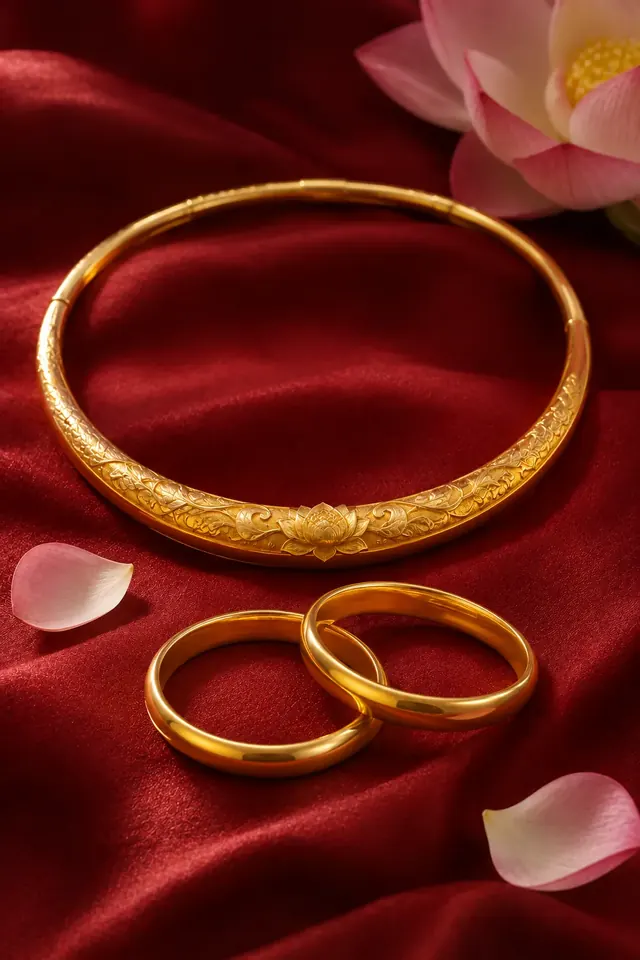
24K is almost pure, so its value lies mainly in the gold weight. It trades at the daily market price with low workmanship, which is why it is chosen for saving, wedding gold, bangles, bracelets and plain traditional rings.
The downside is softness: it scratches, dents and wears with frequent use, and holds stones poorly. 23K (980) has about 2% other metals, making it slightly harder while keeping the deep colour; it is used for bangles, bracelets and traditional jewellery.
Italian 750 (18K): value and durability in balance
750 gold is 75% gold; the 25% alloy makes it much harder, so jewellery keeps its shape, prongs hold stones and the surface stays bright. The name "Italian gold" comes from 18K chains and rings imported from or made with Italian techniques, known for their fine work.
750 is the usual choice for wedding rings, engagement rings, diamond jewellery and daily wear. Many 750 designs at Ngọc Diệp are imported from Italy and Hong Kong.
610, 680 and 710 fashion gold: pretty, hard, affordable
"Fashion gold" (*vàng tây*) is the common name for gold below 75%; in Vietnam the usual purities are 610, 680 and 710. With more alloy, it is hard, scratch-resistant, comes in many designs and costs less than 750.
- 710: close to 750 in colour, for a deep tone at a moderate price.
- 680: a balance of colour and price.
- 610: the most affordable and very durable; good for fashion pieces and gifts.
Note: workmanship is a larger share of the price of fashion gold, so more is usually deducted when selling it back than with 24K. Ask about trade-in before buying.
What are white gold and rose gold?
The colour comes from the alloy:
- Yellow gold: balanced silver and copper keep the natural yellow.
- Rose gold: more copper for a warm pink. The colour is in the alloy, so it does not wear off.
- White gold: palladium or nickel lightens the colour, then a rhodium plating gives a bright white. The plating wears gradually; re-plate every 1–2 years depending on wear.
White gold is not platinum. Platinum is a separate precious metal, heavier and naturally white, with no plating needed.
Which gold should you choose?
| Purpose | Choose | Why |
|---|---|---|
| Saving | 24K gold (plain rings, bars) | High content, low workmanship, market-price trading |
| Wedding gold, traditional gifts | 24K or 23K | Traditional meaning, holds value |
| Wedding and engagement rings | Italian 750 | Hard, keeps shape, holds stones |
| Diamond jewellery | 750 (yellow, rose or white) | Secure prongs, colour flatters the stone |
| Daily wear, work | 750 or 680/710 gold | Durable, scratch-resistant |
| Gifts on a moderate budget | 610 gold | Affordable, wide choice |
How to check purity when buying
- Look for the stamp (750, 610, 999…) and match it to the invoice.
- Ask for an invoice stating purity, weight (chỉ, phân or grams) and unit price.
- Test with an XRF spectrometer in store: non-destructive, with results in seconds. Ngọc Diệp tests purity this way, including jewellery bought elsewhere.
- Keep the guarantee for easy trade-in.
Folk tests such as biting, magnets or flame only catch crude fakes and can damage jewellery; they are no substitute for instrument testing.
Vietnamese gold weight units
| Unit | Equals | Grams |
|---|---|---|
| 1 lượng (cây, tael) | 10 chỉ | 37.5 g |
| 1 chỉ | 10 phân | 3.75 g |
| 1 phân | 10 ly | 0.375 g |
Quick answers
How many karats is 750 gold?
750 gold is 18K, containing 75% pure gold.
Is 610 gold the same as 14K?
Nearly. 610 is 61% gold, about 14.6K; international 14K (585) is 58.5%.
Are 24K and 9999 gold the same?
9999 refers to 24K gold at 99.99% purity; TCVN 7054:2014 requires 24K to be at least 99.9%.
Does fashion gold tarnish?
It can dull with sweat and chemicals; cleaning and polishing restore the shine. Ngọc Diệp cleans jewellery bought in store for free.
Which gold is best for saving?
24K, for its high content and low workmanship at market-price trading; 750 and fashion gold are better for wearing than saving.
How can I know the exact purity?
Match the stamp to the invoice and test with a spectrometer in store; it is fast and does not damage the piece.