Jewellery price = gold weight × gold price for that purity + workmanship + stones (if any). When you sell back, shops pay the buying price (lower than the selling price) and deduct workmanship and stone weight, so 24K loses least while fashion gold and stone-set pieces lose more. Keep your invoice and guarantee, and ask about trade-in before you buy.
What makes up the price?
- Gold value: gold weight (in chỉ or grams) times the price of that purity on the day.
- Workmanship: design, casting, stone-setting, polishing, plating. The finer the design, the higher the charge.
- Stones: diamonds, coloured stones or small CZ stones. Certified diamonds are priced separately by the 4Cs.
Some shops quote an all-in price, others itemise. Either way, the invoice should state purity and weight so you can check.
A worked example
Suppose a 750 gold ring weighs 1.2 chỉ with small stones. The figures below only illustrate the method; they are not real prices:
| Component | Calculation | Amount (illustrative) |
|---|---|---|
| Gold value | 1.2 chỉ × 750 price (assumed 10,000,000 VND/chỉ) | 12,000,000 VND |
| Workmanship | By design | 1,500,000 VND |
| Small stones | By number of stones | 500,000 VND |
| Total | 14,000,000 VND |
Assumed figures. Real gold prices change daily; see Ngọc Diệp’s gold price page.
Buying and selling prices
A gold price board always has two columns: the selling price (what the shop charges you) and the buying price (what it pays you). The spread covers testing, refining, price risk and running costs. For the same gold, a smaller spread is better for customers.
See reference prices on Ngọc Diệp’s today’s gold price.
Why are there deductions when selling back?
- Workmanship is not refunded: most of it is built into the piece and lost when gold is melted.
- Stone weight is deducted: shops weigh the whole piece and subtract the stones, since gold price applies only to the gold.
- Wear and damage: broken or dented pieces must be repaired or melted.
- Older designs: dated designs are hard to resell as they are.
So 24K (low workmanship, no stones) is usually bought back closest to market price, while fashion gold, 750 and stone-set jewellery lose more.
Trade-in policy at Ngọc Diệp Gold Shop
Ngọc Diệp publishes trade-in rates for each gold type (summary of its "Warranty and buy-back" policy):
| Type | Selling back | Exchanging |
|---|---|---|
| 23K–24K gold | At market price | At market price |
| 610/680/710 gold | At market price | Like-for-like when intact and current; broken or older designs −80,000 VND per chỉ |
| Italian 750 gold | −20% within 6 months, −30% after | −15% within 6 months, −25% after |
| Diamond settings | −25% of invoice price | −20% of invoice price |
Rates may change over time; please confirm with staff before any transaction. Full details on the About page.
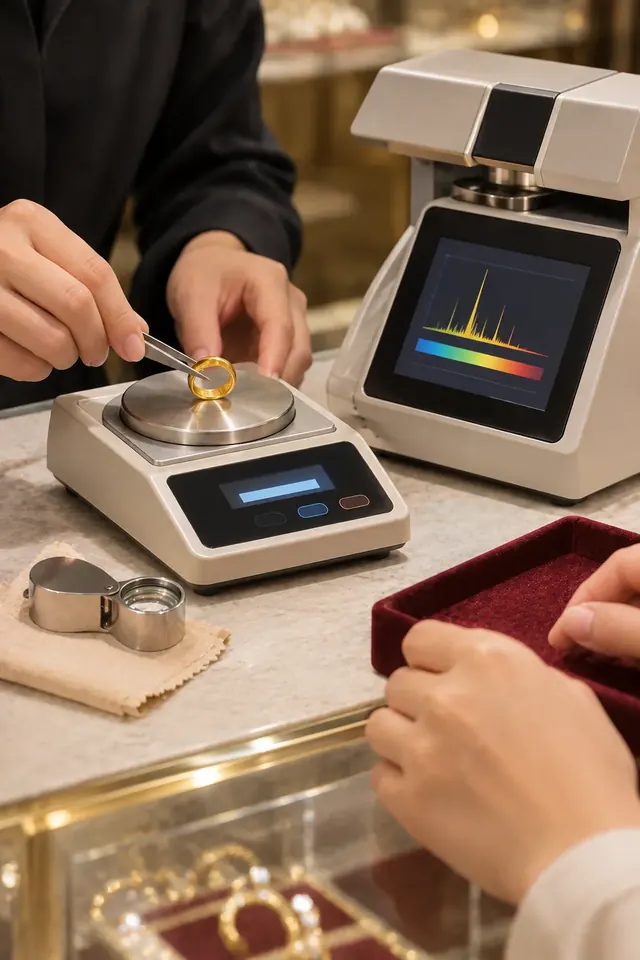
The shop also tests jewellery bought elsewhere with a spectrometer and buys it at the market price.
Reading the invoice and guarantee
A complete jewellery invoice should show:
- Shop name, address and business registration number.
- Item name, purity, total weight and gold weight (if stone-set).
- Gold unit price, workmanship, stone price, total and date.
- For diamonds of 3.6 mm and above: certificate number and 4C grades.
- The warranty and trade-in policy that applies.
Photograph your invoice and guarantee and keep them on your phone. Paperwork makes valuation faster and more accurate.
Tips for buying and trading in
- Know your purpose: for saving, choose low-workmanship 24K; for wearing, choose a design you love, since workmanship pays for beauty.
- Compare the all-in price, not just the gold unit price.
- Ask about trade-in before buying and note the deductions.
- Exchange while pieces are intact for the best rate (like-for-like for fashion gold at Ngọc Diệp).
- Keep jewellery clean and unbroken; have clasps repaired promptly.
- Bring your invoice, guarantee and ID for large transactions.
Important note
This guide explains how jewellery is valued; it is not investment advice. Gold prices move with the market; for large purchases or sales, consider carefully and ask the shop directly.
Quick answers
How is the price of gold jewellery calculated?
Gold weight times the price for that purity on the day, plus workmanship and any stones.
Why do I lose money selling jewellery back?
Workmanship is not refunded, stones are deducted from the weight, and shops pay the buying price, which is below the selling price.
Which gold loses least when sold back?
24K, with high content, low workmanship and no stones; at Ngọc Diệp, 23K–24K is bought and sold at market price.
What is deducted when exchanging fashion gold at Ngọc Diệp?
Nothing if the piece is intact and current (like-for-like); broken or older designs lose 80,000 VND per chỉ, per the published policy.
Does Ngọc Diệp buy gold bought elsewhere?
Yes. It is tested with a spectrometer, weighed transparently and bought or exchanged at market price.
Can I sell without an invoice?
Usually yes after purity testing and weighing, but an invoice and guarantee make valuation faster and more accurate.